
Data monetization meaning, strategy, and use cases for executives. Covers types of data monetization, big data monetization, and how to monetize data assets across healthcare, telco, IoT, and enterprise environments.
Most organisations are sitting on data that generates no financial return. Customer behaviour, operational transactions, sensor readings, supplier interactions — these are assets in the accounting sense only when they begin to generate value beyond the function that created them.
Data monetization is the process of converting data assets into measurable economic value. That value may come from internal decisions that reduce cost or improve margin, from new products and services built on data, or from commercial arrangements where data is licensed, packaged, or sold to external parties.
This page covers what data monetization actually means for leadership teams, the types of data monetization available to organisations, common use cases by industry, and what strategic decisions must be made before any data monetization initiative is likely to succeed.
The question is not whether you have data. The question is whether it is governed well enough to monetize.
The phrase “data monetization” is used loosely, which causes confusion. Some executives assume it means selling raw datasets to third parties. Others frame it as improving analytics. Both are correct — but incomplete.
A working data monetization meaning for leadership purposes is: any mechanism by which an organisation extracts economic value from data that it owns, collects, or has the right to use.
That includes:
Understanding which of these categories applies to your organisation is the first strategic decision. It determines governance requirements, risk exposure, regulatory considerations, and the internal capabilities needed.
McKinsey’s research on data monetization highlights that organisations capturing the most value from data are those that treat it as a strategic asset — with clear ownership, quality standards, and executive accountability — rather than a byproduct of operations.
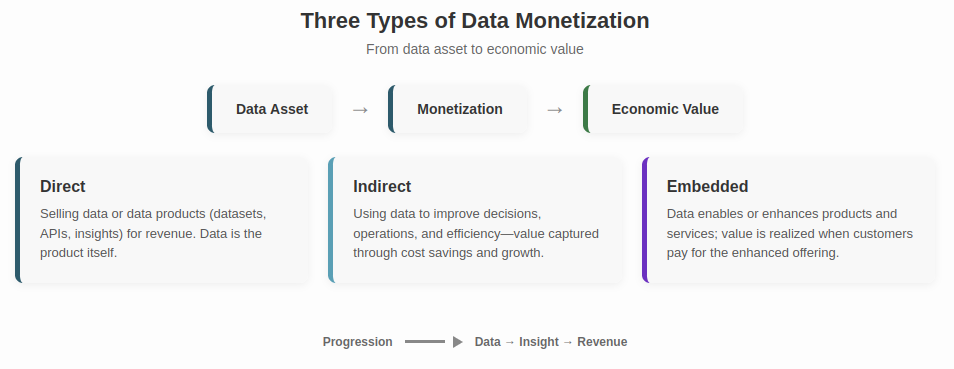
The four primary types of data monetization operate differently in terms of risk, complexity, and return:
Using data to make better internal decisions. This includes dynamic pricing, demand forecasting, churn prediction, fraud detection, and supply chain optimisation. The economic return is realised through cost reduction, margin improvement, or revenue protection — not from a direct sale.
This is the most common entry point. It requires strong data governance and clean operational data, but does not typically require external data sharing agreements or significant regulatory navigation.
Building products whose core value is data-derived. Benchmarking reports, industry intelligence subscriptions, performance analytics platforms, market trend feeds — these are products where the data itself, or the insight derived from it, is the commercial offering.
This model requires investment in data product design, packaging, pricing, and customer acquisition. It also raises questions around data ownership, anonymisation, and contractual protections that must be resolved before launch.
Sharing or licensing raw or processed data to third parties — partners, research institutions, advertisers, insurers, or data aggregators. Revenue may be transactional or recurring. This model carries the highest regulatory and reputational exposure, particularly where personal data is involved.
Snowflake’s overview of data monetization fundamentals addresses the infrastructure and commercial mechanics of making data available to external parties through marketplaces and secure sharing environments.
Using advanced analytics or AI models — trained on proprietary data — to generate insights, recommendations, or automated decisions that improve customer outcomes or operational performance. Where the model output is embedded into a product or service, this becomes a source of competitive moat: the underlying data advantages are difficult for competitors to replicate.
Organisations often find it easier to evaluate data monetization when they see concrete use cases in their sector. The following data monetization examples illustrate how different industries are approaching this.
Data monetization in healthcare requires navigating significant regulatory complexity — patient data privacy, consent frameworks, and sector-specific obligations. However, the potential value is substantial.
Examples include:
The governance requirements in healthcare are non-negotiable. Any data monetization initiative must begin with a legal and ethical assessment of what data can be used, under what conditions, and with what level of consent.
Telecommunications providers generate extraordinary volumes of behavioural, location, network, and device data. Telco data monetization is a well-established model, with multiple commercial avenues:
The primary tension in telco data monetization is between commercial opportunity and regulatory obligation. In regulated markets, the use of subscriber data for commercial purposes is increasingly restricted, requiring telcos to invest in robust consent management, anonymisation, and data governance infrastructure before these models are viable.
Industrial and connected environments generate continuous streams of sensor, machine, and operational data. IoT data monetization takes several forms:
The challenge in IoT data monetization is data quality and interoperability. Sensor data often requires significant cleaning and contextualisation before it carries enough analytical value to monetize. This is where data governance and lineage management become critical.
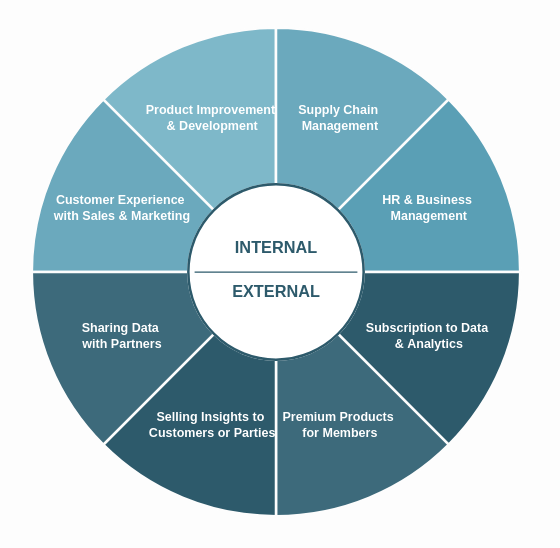
Internal — Data drives operational efficiency, product improvement, and decision-making.
External — Data generates revenue through products, insights, or partnerships.
Monetize customer data responsibly requires balancing commercial opportunity with consent, privacy, and regulatory obligation. Customer behaviour, purchase history, location, and engagement signals are among the most valuable datasets organisations hold — but they also carry the highest reputational and legal risk when used carelessly.
To monetize customer data without losing trust:
Prioritise consent and transparency. Customers must understand what data is collected, how it will be used, and whether it may be shared or sold. Opaque terms or buried consent clauses erode trust and increase regulatory exposure under GDPR, POPIA, and CCPA.
Anonymise or aggregate before external sharing. Where customer data is licensed or sold to third parties, robust anonymisation or aggregation removes individual identification. This reduces privacy risk while preserving analytical value for many use cases.
Assign clear ownership. Customer data used in monetization initiatives must have an accountable owner who is responsible for quality, consent compliance, and appropriate use. Without ownership, data drifts into grey areas where misuse becomes likely.
Document the governance model. External buyers, partners, and auditors increasingly expect proof that data has been collected and handled in line with declared policies. Documented governance — consent records, lineage, access controls — makes customer data monetization defensible.
Organisations that monetize customer data without these foundations risk regulatory sanctions, customer backlash, and lasting reputational damage. The organisations that do it well treat customer trust as a prerequisite, not an afterthought.
Big data monetization introduces a set of considerations that do not apply at smaller scales. When data volumes are large — billions of transactions, continuous sensor feeds, multi-year behavioural datasets — the infrastructure and governance requirements change materially.
Three factors determine whether big data monetization is viable:
1. Data quality at scale. Large datasets amplify the impact of quality problems. A 2% error rate in a small dataset is manageable. At scale, it introduces millions of corrupted records, broken pipelines, and unreliable model inputs. Any big data monetization initiative requires investment in data quality monitoring, lineage tracking, and master data governance before the data can be treated as a reliable asset.
2. Infrastructure for access and sharing. Monetizing large datasets typically requires platforms that can package, secure, and distribute data efficiently. Cloud data platforms, data marketplaces, and API-based data sharing infrastructure all play a role. AWS provides guidance on data monetization architecture for organisations building scalable data products on cloud infrastructure.
3. Governance at the same scale as the data. Governance cannot be retrofitted after a big data monetization programme is underway. Ownership, quality standards, access controls, and audit trails must be established before data is made available — internally or externally. Without these, the legal and reputational exposure from a data incident is proportional to the volume of data involved.
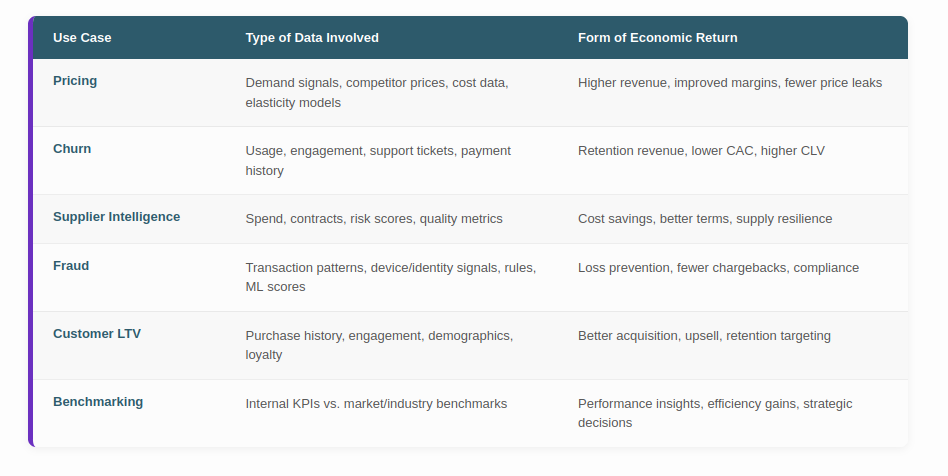
Across engagements and sectors, certain data monetization use cases consistently demonstrate measurable returns:
The use cases that deliver the most consistent value share two characteristics: they are built on governed, reliable data, and they are connected to a specific decision that leadership already needs to make.
The landscape of data monetization companies spans several distinct categories, and executives need to understand where they sit relative to this market.
Data brokers and aggregators — companies like Nielsen, Experian, and IRI — have historically been the dominant force in third-party data markets. They aggregate data from multiple sources, build proprietary datasets, and sell access to advertisers, financial institutions, and market researchers.
Data marketplace platforms — including Snowflake Data Marketplace, AWS Data Exchange, and Bloomberg Terminal — provide infrastructure for organisations to publish and monetize their own data assets alongside accessing third-party data. These platforms reduce the commercial and technical friction of data sharing.
Analytics and data product companies — firms that convert raw data into packaged analytical products: benchmarking services, industry intelligence platforms, risk scores, and market indices. Their competitive advantage is the proprietary nature of the data they have accumulated and the analytical models they have built on top of it.
Enterprise data monetization platforms — technology providers that help organisations operationalise internal data monetization: managing data quality, consent, access control, and packaging for external sharing. These tools sit between the data source and the commercial model.
For organisations considering data monetization for the first time, understanding where your data assets fit in this landscape — and which category of commercial model is most viable — is essential before making infrastructure or partnership investments.
Gartner’s data monetization framework provides a structured approach to assessing data monetization maturity and identifying the most appropriate models for a given organisation’s context and risk profile.
Fueling growth through data monetization requires more than identifying an opportunity. It requires an organisational foundation that makes the opportunity exploitable.
The most common reason data monetization initiatives stall is not a lack of data. It is a lack of governance. Data that is ungoverned — without clear ownership, quality standards, or documented lineage — cannot reliably support a commercial model. It cannot be licensed without legal exposure. It cannot be productised without quality assurance. It cannot be used in AI models without auditability.
The prerequisites for any serious monetize data assets programme are:
Data ownership. Every dataset that will be part of the monetization model must have an assigned owner who is accountable for its accuracy, quality, and appropriate use. Without ownership, there is no accountability when something goes wrong.
Data quality standards. Monetizable data must meet defined quality thresholds — completeness, accuracy, consistency, and timeliness. Quality standards must be measurable and monitored, not assumed.
Lineage and auditability. When data is used in a commercial context — particularly in regulated industries — organisations must be able to trace where data came from, how it was transformed, and who has accessed it. Lineage is not optional in a monetization context.
Legal and regulatory clarity. The regulatory landscape for data monetization is evolving rapidly. GDPR, POPIA, CCPA, and sector-specific regulations impose constraints on how personal data may be used, shared, and sold. Legal assessment must precede commercialisation, not follow it.
Commercial model design. The governance infrastructure must align with the commercial model. A licensing model requires different access controls than an internal analytics product. A benchmarking service requires different anonymisation standards than a pricing optimisation tool.
These foundations are not overhead. They are the mechanism by which data monetization becomes defensible — to customers, regulators, and boards.
Monetizing data management refers to the operational disciplines that make a data asset commercially usable. This includes:
Organisations that invest in these disciplines before launching a data monetization programme avoid the most expensive failure mode: discovering mid-launch that the data they intend to commercialise does not meet the quality or governance standards required.
A data monetisation strategy is not a technology roadmap. It is a set of leadership decisions about which assets to commercialise, how, under what governance model, and with what risk tolerance.
Independent advisory helps organisations make these decisions before commitments are made. This means:
The organisations that generate the most durable value from data monetization are not necessarily those with the most data. They are the ones that know exactly which data they have, who owns it, and what it can reliably support.
What is data monetization?
Data monetization is the process of converting data assets into measurable economic value — through internal decision improvement, new data products, or commercial arrangements where data is licensed or sold. It covers direct, indirect, and embedded models.
What are the main types of data monetization?
The four primary types are: (1) internal value creation (using data for better decisions), (2) data products and services (selling data-derived products), (3) data licensing and partnerships (sharing or licensing to third parties), and (4) AI and analytics monetization (embedding model outputs into products or services).
How do you monetize customer data without losing trust?
Prioritise consent and transparency, anonymise or aggregate before external sharing, assign clear data ownership, and document your governance model. Customer data monetization requires governance first — trust is the prerequisite, not an afterthought.
What industries use data monetization?
Data monetization is used across healthcare (outcome data, claims analytics), telecommunications (location, network, and behavioural data), IoT and manufacturing (sensor and telematics data), retail (loyalty and transaction data), and financial services (benchmarking, risk models). Each sector has distinct governance and regulatory considerations.